
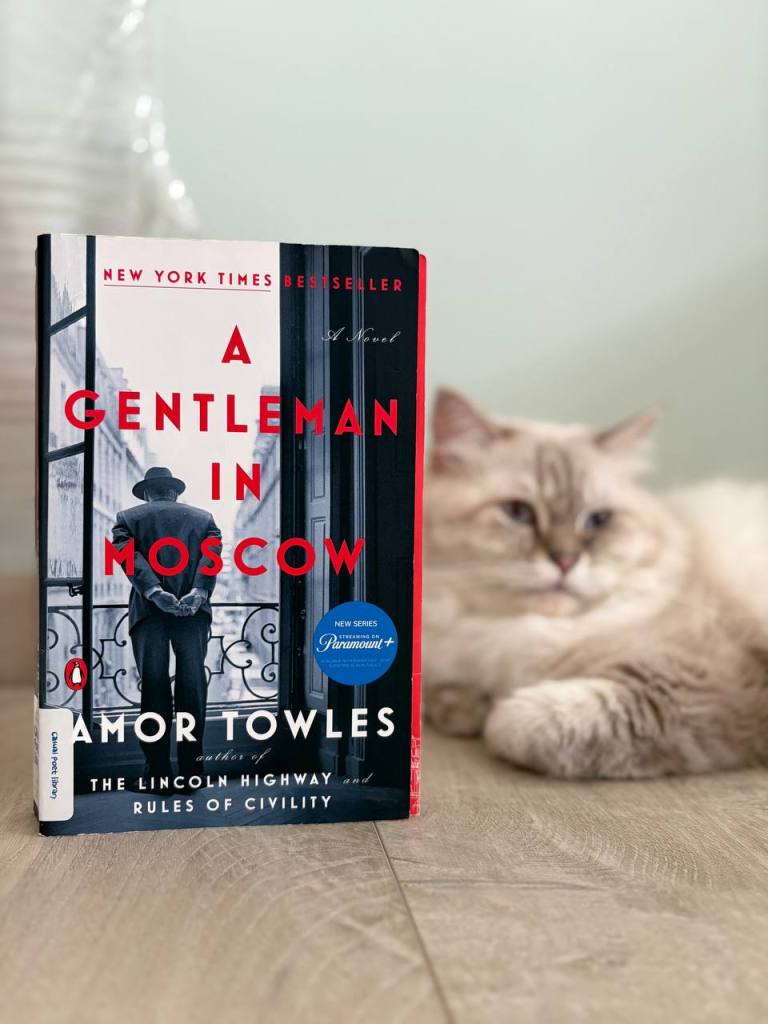
“If a man does not master his circumstances, then he is bound to be mastered by them.”
This was my very first step into historical fiction. And what a step it was. I will admit that the opening tested my patience. In a good way. Towles writes with a deliberate elegance and I found myself needing more than a moment to adapt. But once I did (after 259 pages), the rest of that reading experience was glorious.
The premise for A Gentleman in Moscow is deceptively simple: in 1922, Count Alexander Rostov is sentenced to spend the rest of his life under house arrest at the Metropol Hotel in Moscow. His world shrinks to a single building, in both a sanctuary and cage, a place where the tides of history ebb and flow just outside walls.
Yet the story that unfolds is expansive and brimming with life. Life inside carrying on in its own measured way. Towles paints this duality beautifully by showing us how freedom can exist in the mind, how grace can be maintained in the face of change, and how dignity is a choice.
What captivated me most was the human connections created and endured through it all. Friendships blossomed in the dining room. Life exchanges through the clinking of glasses. Love, especially parental love, found in the most unexpected forms. It was beautiful to behold.
By the time I reached the last page, I felt as though I had shared decades with the Count. Witnessing his triumphs, his losses, the way he navigated them through it all. And when it ended, I was gutted. It is that rare kind of book that leaves you hollow for a while, as if knowing you have said goodbye to someone you deeply cared for, someone you cannot keep in touch with.
Would I recommend A Gentleman in Moscow? A resounding yes. Before reading it, I would not have considered historical fiction my favourite genre. But this novel changed that. If you enjoy slow-unfolding narratives with emotional depth, there is a good chance you will love this as much as I did.
 a reader’s final fantasy