
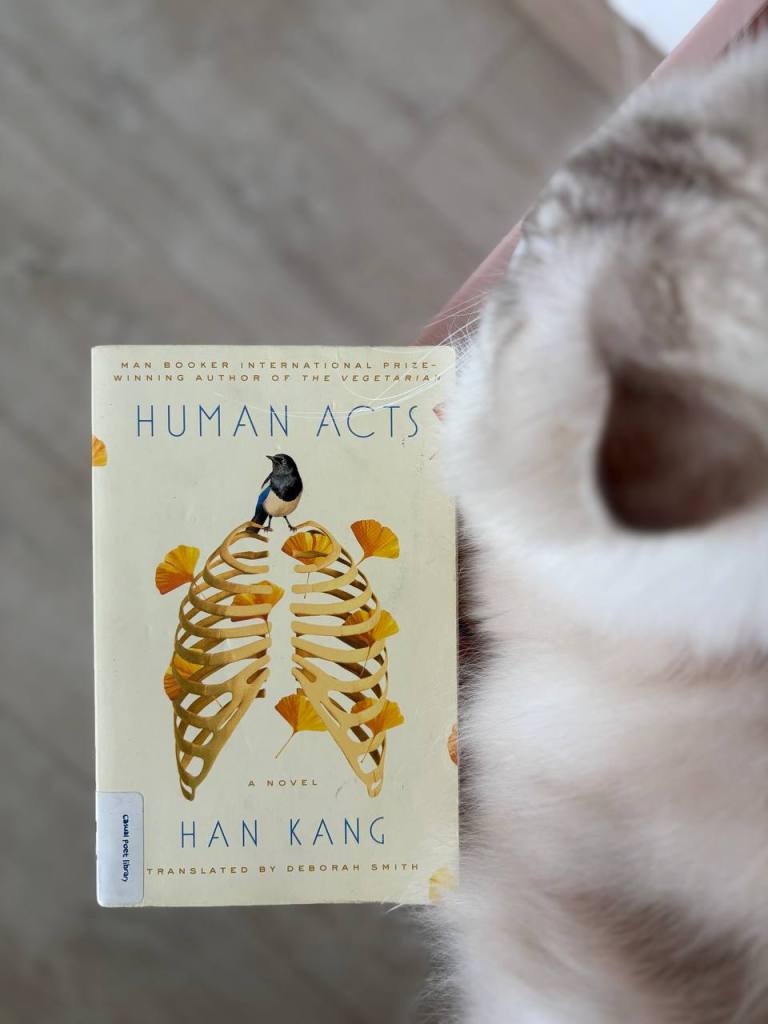
I really should not judge a book by its cover, but the aesthetics for this book was too beautiful for me to resist purchasing while on vacation in Hong Kong a few months back. And honestly, who can say no to another translated work of art?
The premise for Human Acts was certainly not what I had in mind (think philosophical questions about what it means to be human). When I found people dead in the introduction (or what is also known as the foreword), I realised this novel was far greater than I had anticipated.
Human Acts examines the political violence and collective trauma surrounding the 1980 Gwangju Uprising in South Korea through multiple perspectives of the deceased, victims, and survivors alike in depicting the massacre and subsequent psychological and social repercussions. I do not know how to best describe the prose style apart from poetic and lyrical, but that is probably the most concise one I could think of. For Kang to sustain this tone without diminishing the brutality of the event was phenomenal; for Smith to translate it without minimising the severity was equally remarkable.
I could not help but feel curious about both author and translator. A quick Google search revealed that Kang had recently been awarded the 2024 Nobel Prize in Literature, and both Kang and Smith were co-winners of The Man Booker International Prize in 2016.
Beyond their accolades, the story further explores grief and the struggle for truth in the face of state-sanctioned erasure. The persistence of trauma across decades, the moral implications of bearing witness, and the ways in which individual identity and collective history are shaped served as both a political statement and a meditation on the human condition under extreme oppression. Reading the book also made me reflect on the many tragic events South Korea has experienced, making them feel even more pronounced. The Itaewon stampede, the Sewol ferry disaster, and the Jeju Air crash, among others. A nation can hold so much grief and still endure.
Would I recommend Human Acts? Yes. It may not be an easy read, but it is a necessary one, a stark reminder that brutality still exists and that bearing witness and remembering, however painful, are acts we cannot afford to neglect in understanding our shared humanity.
 a reader’s final fantasy