
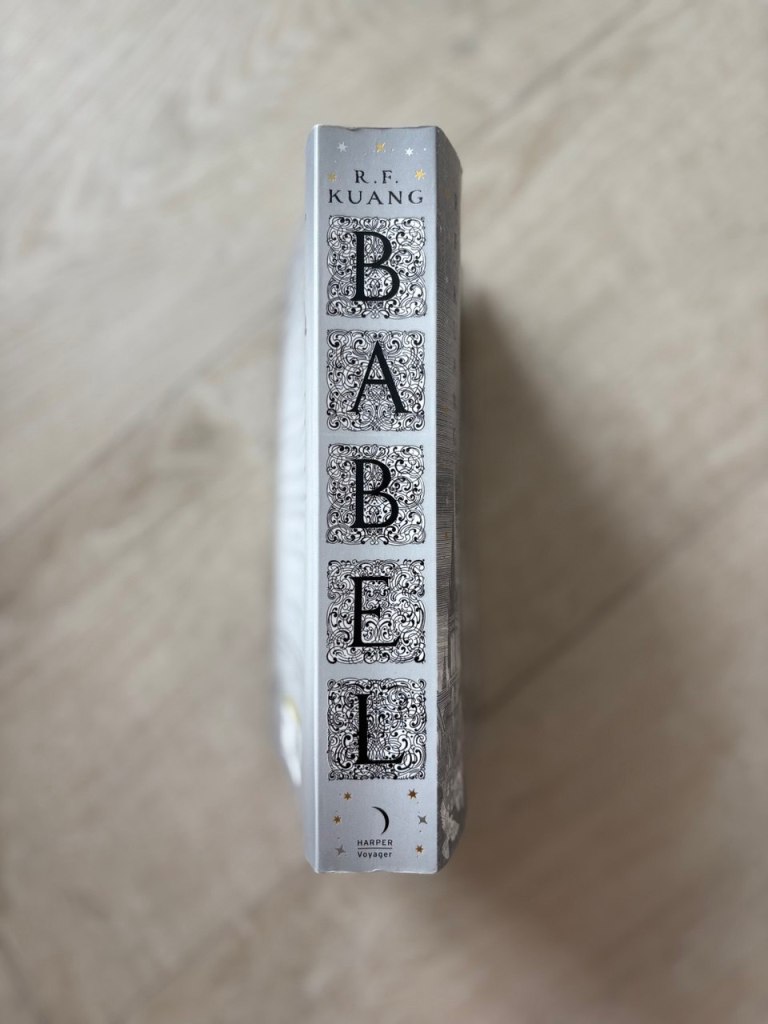
When one of my friends lent me Babel from her personal collection, I marvelled at the intricacies of the cover design and felt a sense of obligation towards it. I told myself that I had to take care of this book and keep it in pristine condition. At the same time, I was excited to immerse myself into discovering a new world of fantasy infused with historical elements.
Babel is a dark academic historical fantasy set in 19th-century Oxford, where the protagonist, Robin Swift, is brought to England to study translation at a prestigious school. At the heart of the story lies a magical system powered by enchanted silver bars in the midst of colonialism. And this is where I have to admit: I did not enjoy the book very much.
I really wanted to like this, but the world-building simply did not cut it for me. While categorised as historical fantasy, the narrative seemed to move along almost entirely within the frame of real history, with the only fantastical element being the use of silver imbued with magic. I could not engage with the book and even dozed off multiple times while listening to the audiobook alongside the text, much to the amusement of my husband, who reported having found me asleep in an awkward position with the narration still playing in the background.
For all my struggle to stay engaged, the remarkable depth of research that went into creating this book is undeniable. I did enjoy learning more about linguistics, which I felt was accessibly written for non-linguists. Kuang truly proved herself a meticulous scholar, but again, the fantasy aspect felt sorely underdeveloped. Perhaps I might be biased, having spent a few years studying in the United Kingdom, as the setting felt less like a new world and more like an extension of what I was already familiar with.
What ultimately pulled me out of the story, however, was not the setting but the characters themselves. I could not find it in myself to connect with any of them, except for Letty, though she was clearly intended to be disliked. That said, the ending was brilliantly unexpected. Robin remained only human from beginning to end, and perhaps that was the point. Maybe Kuang meant to show that even with language as a bridge to connect, there are still limitations that cannot be overcome.
Would I recommend Babel? Perhaps selectively. I would recommend it to readers who are more drawn to rigorous historical detail than to imaginative world-building. For readers seeking immersive fantasy and emotionally compelling characters (like me), it may fall short.
 a reader’s final fantasy